How do heat pumps work?
The technology behind a warmer, lower-carbon home — in plain English.

A heat pump doesn't burn anything to make heat. It moves heat that's already there — pulling warmth from the outside air (or the ground) and concentrating it to warm your home and your hot water. Think of it as a fridge working in reverse: a fridge moves heat out to keep food cold, a heat pump moves heat in to keep you warm.
That one difference is why heat pumps matter. Because they move heat rather than create it, they can deliver around three units of warmth for every unit of electricity they use. A gas or oil boiler, however good, can only ever give back a little less than the fuel it burns.
Here's how that works, and what it means for your home.
The short answer
A heat pump takes low-grade heat from outside, raises it to a useful temperature using a refrigerant and a compressor, and passes that warmth to your radiators, underfloor heating and hot water. It runs on electricity, produces no flame, no fumes and no carbon at the point of use, and it keeps working even when it's cold outside.
A fridge in reverse: the four steps
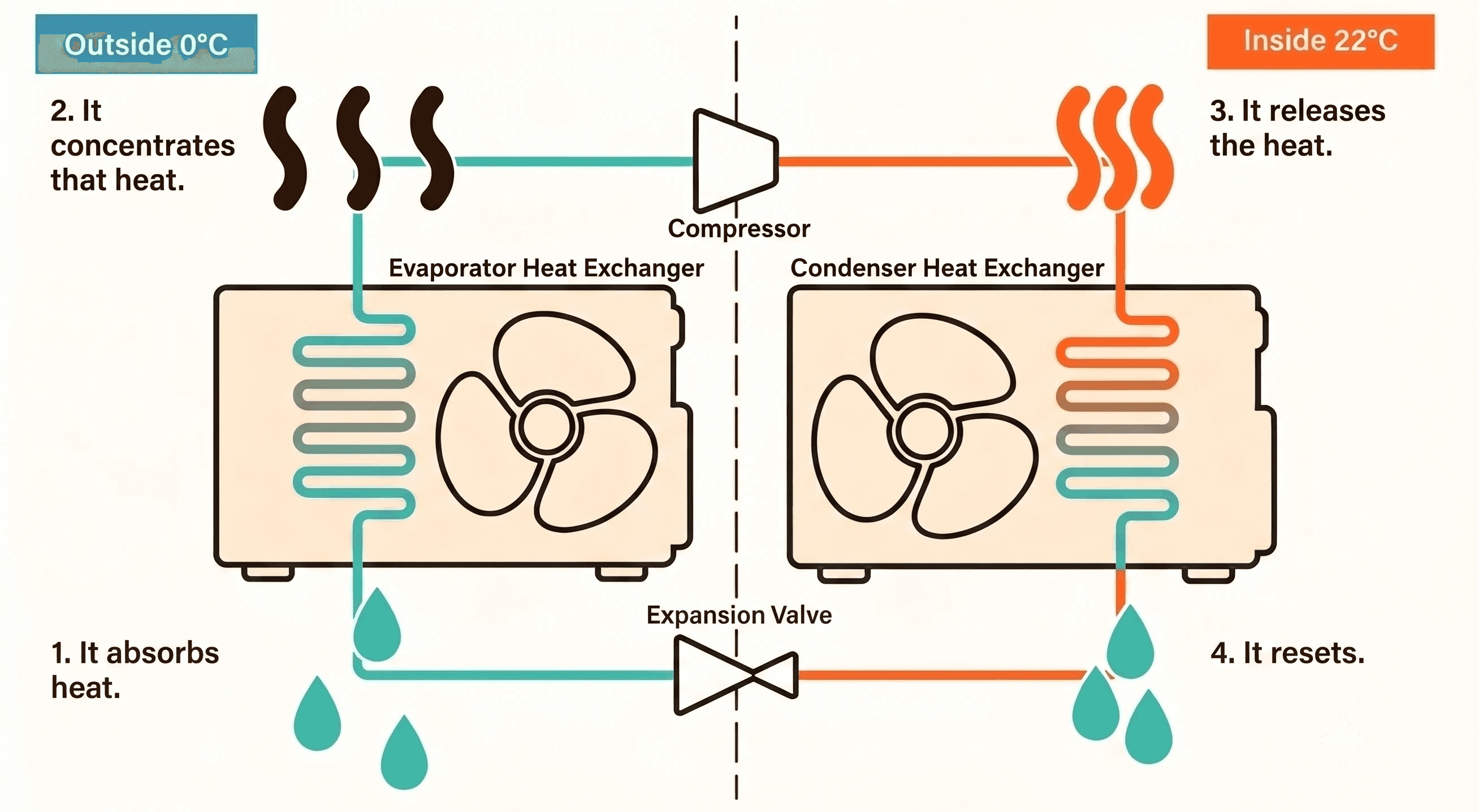
Every heat pump runs the same simple cycle, over and over:
It absorbs heat. A cold liquid refrigerant flows through a coil exposed to the outside air. Even air that feels cold to us holds plenty of heat, and the refrigerant is colder still — so heat flows into it and the refrigerant turns to gas.
It concentrates that heat. A compressor squeezes the gas. Squeezing anything makes it hotter, so this step raises the temperature to something useful for heating your home.
It releases the heat. The hot gas passes through a heat exchanger connected to your heating system. It gives up its warmth to the water in your radiators or underfloor pipes, and to your hot water cylinder.
It resets. As the refrigerant cools, it turns back into a liquid, an expansion valve drops its pressure, and the cycle begins again.
No burning, no flame, no flue. Just heat moved from outside to in.
Air source or ground source?
There are two main types, and they work on the same principle — they just draw heat from different places.
An air source heat pump takes heat from the outside air. It's a unit that sits outside your home, roughly the size of a large washing machine. It's the most common choice in UK homes because it's simpler and less expensive to install.
A ground source heat pump draws heat from the ground through pipes buried in your garden. The ground stays at a steadier temperature year-round, so it can be a touch more efficient — but it needs space and more groundwork, which makes it a bigger project.
For most homes, air source is the natural starting point. If you'd like a sense of the numbers, our guide to how much a heat pump costs breaks it down.
Why heat pumps are so efficient
A boiler turns fuel into heat, and some of that energy is always lost. A heat pump doesn't make heat at all — it gathers and moves it. That's why a well-designed heat pump typically produces around three units of heat for every unit of electricity it uses, where a boiler gives back a little less than one.
That ratio is called the coefficient of performance. Real-world efficiency depends on how well the system is designed and how well your home holds heat — which is exactly the kind of detail worth getting right at the survey stage, rather than guessing.
Do heat pumps work in winter?
Yes. This is the question people ask most, and the answer is a firm one: heat pumps are designed for cold weather and are used across Scandinavia, where winters are far harsher than ours. Modern air source units keep working in temperatures well below freezing.
The trick is that a heat pump runs at a lower, steadier temperature than a boiler — warming your home gently and continuously rather than in short, hot blasts. It's a different kind of warmth, and most people find it more comfortable once they're used to it. We go into more detail in how heat pumps work in winter.
What your home needs
Most UK homes are more ready for a heat pump than people think. A heat pump works best with a home that holds its heat reasonably well and a heating system sized to run at lower temperatures — which sometimes means a few larger radiators, sometimes nothing at all.
The only way to know for certain is a proper heat-loss survey, where an engineer measures how your specific home loses heat and designs a system around it. That's the difference between a heat pump that quietly does its job and one that struggles.
Ready to see what it means for your home?
Understanding how heat pumps work is the first step. The next is seeing what one would look like in your home — the warmth, the running costs, the grant you're entitled to.
Don't wonder. Know.
Get an estimate in minutes, with no survey and no obligation.
Frequently asked questions
Do heat pumps use a lot of electricity?
They use electricity to run, but because they move heat rather than burn fuel, they deliver around three times more heat than the electricity they draw. For homes coming off oil or LPG, running costs are often comparable or lower.
Are heat pumps noisy?
No. A modern air source heat pump runs at about the level of a quiet fridge or gentle background hum. You'll barely notice it outside, and you won't hear it indoors.
Can a heat pump heat my water too?
Yes. A heat pump heats your hot water as well as your home, usually stored in a hot water cylinder ready for when you need it.
Do I need underfloor heating?
No. Heat pumps work well with radiators, though some may need to be a little larger to run efficiently at lower temperatures. Underfloor heating is a good match but not a requirement.
Is it a lot of upheaval to install?
Less than most people expect. A typical installation takes a few days. With the Heat Pump Plan, we manage the whole thing — survey, grant, install and paperwork — so you're not left coordinating it yourself.
Book a consultation call
Speak to one of our experts about a heating upgrade