Dorset homes love a heat pump
No mess. no refills.
Just steady warmth, whatever the weather.
payments
Costly refills
casino
Unpredictable bills
emergency_home
Risk of dangerous leaks

From Swanage to Sherborne, charming homes across the county have relied on oil deliveries for decades.
If yours is one of them, there has never been a better time to consider upgrading to a heat pump.
A well-designed system fits all of it, from the cob and thatch in the Blackmore Vale to Purbeck stone on the coast.

Still on Oil? Why you should get a heat pump.
A heat pump isn't a replacement - it's an upgrade fit for the future.
No tank, no deliveries, no running out on a cold weekend.
*Data & References
Source: Energy Savings Trust. Efficiency figures are seasonal averages (SCOP) for typical installations; performance varies by home.
Boiler Upgrade Scheme (England & Wales): £7,500 for most homes; £9,000 for homes replacing oil or LPG heating, for grant applications made on or after 21 July 2026 (scheduled to run to 31 March 2027). Eligibility criteria apply; grant value is deducted from your quoted price.
Cooling available on compatible systems, configured at install.
How much is your oil boiler costing you?
Use our calculator to see what you could be saving with a heat pump.
why ample
Local experts for better outcomes
Dorset builds in cob, thatch, Purbeck stone and flint, much of it solid-walled and a good deal of it in conservation areas. Every property type has unique characteristics that should be taken into account when designing a heat pump system.
Whether your home is a cob and thatch cottage near Sturminster Newton, a Purbeck stone house in Wareham or a Georgian terrace in Sherborne, we have experts who have years of experience with homes just like yours.

Heat Pump Grants and Incentives
Get up to £9,000 towards your heat pump
The Boiler Upgrade Scheme (BUS) is available to most homes and can take a significant chunk off the cost, making clean heating the easy choice. We handle the paperwork and apply on your behalf - one less form for you to fill in.

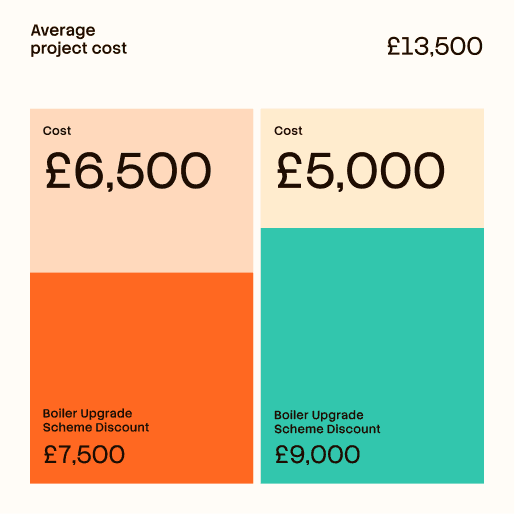
Boiler Upgade Scheme Details
Boiler Upgrade Scheme (England & Wales): £7,500 for most homes; £9,000 for homes replacing oil or LPG heating, for grant applications made on or after 21 July 2026 (scheduled to run to 31 March 2027). Eligibility criteria apply; grant value is deducted from your quoted price.
What might an upgrade cost?
Almost all homes in Dorset are suitable for a heat pump. Answer a few questions below and get a bespoke estimate in just two minutes.
The highest standards, every step of the way
From first survey to final sign-off, the work we back meets the standards that matter — accredited, certified and independently recognised.



Loved by customers you can talk to
Frequently asked questions
We've heard every question going — here are the ones that come up most.

The oil tank is removed as part of your installation, and is disposed of responsibly.
£7,500 through the Boiler Upgrade Scheme, or £9,000 if your home is off the mains gas grid and currently on oil or LPG (from 21 July 2026). We apply for it on your behalf.
For most oil homes, yes. Running costs are close to or better than oil today, oil prices swing (they doubled between January and March this year), and you qualify for the higher £9,000 grant.
Usually, yes — and cob suits a heat pump better than most people expect. A major government-backed study by the Energy Systems Catapult found no type or age of UK home unsuitable for a heat pump, as long as it's designed and installed correctly. Cob walls are thick and hold heat well, which fits the steady, low-temperature warmth a heat pump gives you rather than the on-off cycling of a boiler. The thing to get right is moisture: cob and thatch need to stay breathable, so the design has to work with the building rather than seal it up. That's a design question, not a reason to rule it out. Your survey will show exactly what your home needs.
Usually yes, and it is worth knowing which designation actually changes anything. Being inside the Dorset National Landscape doesn't restrict a heat pump on its own — that designation isn't what decides it. The Dorset and East Devon Coast World Heritage Site and any conservation area both carry the same extra siting rule: the outdoor unit can't go on a wall or roof that fronts a highway, or nearer the road than the house itself. For most homes that means putting it at the side or the back. Listed buildings sit outside permitted development altogether and need listed building consent, and a few areas carry an Article 4 direction. We check the planning position for your home before you commit.